 |
||
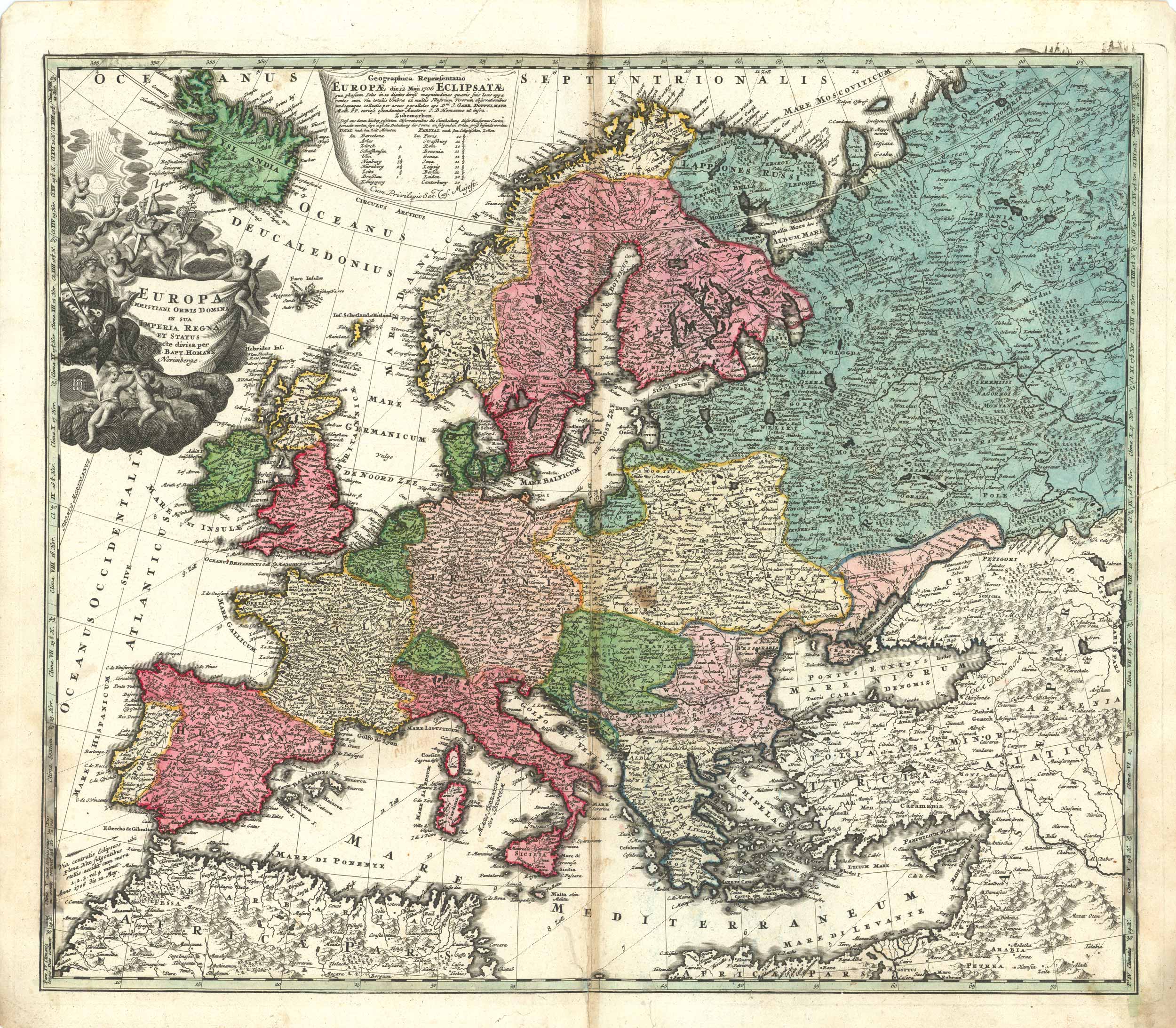
Europa, Christiani Orbis Domina in Sua Imperia, Regna et Status Exacte Divisa (Europe), 1720
In stock
This map of Europe, appeared in Homann’s Atlas Scholasticus. The title page of the atlas is labeled “Atlas Minor XXVI. Selectarum Tabularum Geographicum Homanni Secundum Methodum Huberni aliorumque recentorium geographorum dispositus et recognitus” – which translates as a selection of 26 geographic maps by Homann, arranged and revised according to the method of Hübner and other recent geographers. This scarce atlas, referred to as a Kleiner (meaning small/minor) atlas, included 26 selected maps by Homann, guided by Johann Hubner. This atlas also included a copper engraved, hand-colored title page as frontispiece from the Atlas Novus Terrarum Orbis Imperia by M. Rössler. Based on research, this atlas was most likely compiled between 1720 – 1737.
This map is loosely translated, “Europe, Mistress of the Christian World, in its Empires, Kingdoms, and States, Accurately Divided.” is a carefully detailed representation of Europe, portraying the continent as the dominant sphere of the Christian world. Unlike more general maps, it emphasizes political divisions with precision, showing empires, kingdoms, principalities, duchies, and other territorial entities as they existed in the early 18th century. Major cities, rivers, mountain ranges, and coastal regions are depicted, providing both geographic and political context. . Serving as both a scholarly reference and a decorative object, the map illustrates Europe not only as a geographic region but also as a cultural and political heart of the Christian world, reinforcing European identity and dominance in the early modern period.
Johann Baptist Homann (1663-1724) was a mapmaker who founded the famous Homann publishing company. He lived his entire life in Bavaria, particularly in Nuremberg. Initially, Johann trained to become a priest before converting to Protestantism and working as a notary. In 1702, Johann founded a publishing house that specialized in engravings. The firm flourished, becoming the leading map publisher in Germany and an important entity in the European map market. In 1715, Johann was named Imperial Geographer to the Holy Roman Empire by Charles VI and made a member of the Prussian Academy of Sciences. Most importantly for his business, his reputation and contacts gained him imperial printing privileges which protected his publications and recommended him to customers. That privilege was noted on his maps as “Cum Priviligio.” Johann is best known for this Grosser Atlas ueber die ganze Welt, or the Grand Atlas of the World, published in 1716. After Johann died in 1724, the map plates and management of the company passed to his son, Johann Christoph (1703-1730). In Johann Christoph’s will, he stipulated that the company would be inherited by his two head managers – and that it would publish only under the name “Homann Heirs.” The firm continued in business until 1848.
Condition: Very Good - brightly colored, staining along centerfold
Medium: Copper Engraving
Map Maker: Johann Baptist Homann
Coloring: Original Hand Color
Year: ca. 1720
In stock