 |
||
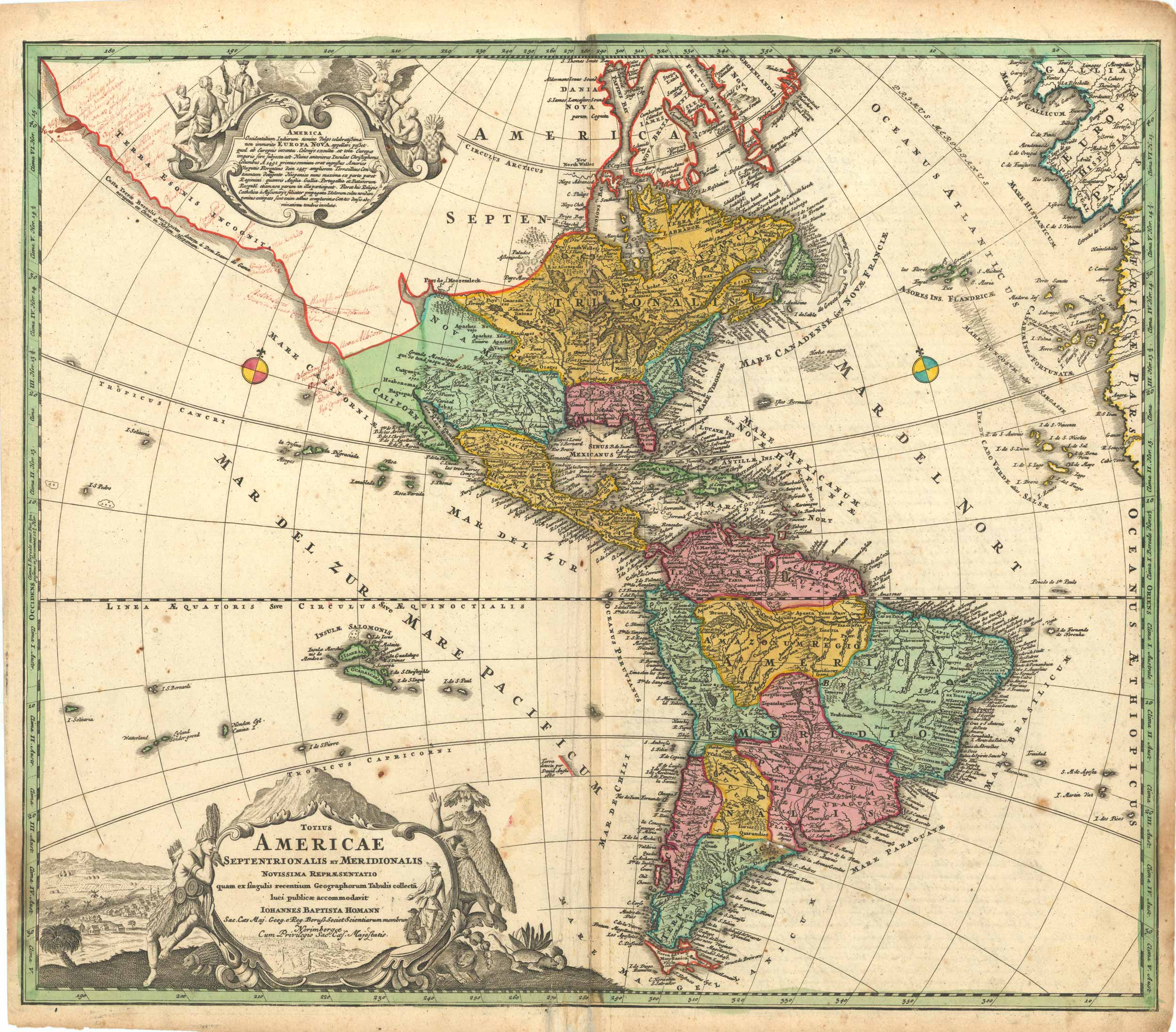
Totius Americae Septenrionales et Meridionalis (North & South America)
In stock
This map of the Americas, appeared in Homann’s Atlas Scholasticus. The title page of the atlas is labeled “Atlas Minor XXVI. Selectarum Tabularum Geographicum Homanni Secundum Methodum Huberni aliorumque recentorium geographorum dispositus et recognitus” – which translates as a selection of 26 geographic maps by Homann, arranged and revised according to the method of Hübner and other recent geographers. This scarce atlas, referred to as a Kleiner (meaning small/minor) atlas, included 26 selected maps by Homann, guided by Johann Hubner. This atlas also included a copper engraved, hand-colored title page as frontispiece from the Atlas Novus Terrarum Orbis Imperia by M. Rössler. Based on research, this atlas was most likely compiled between 1720 – 1737.
This map’s title is translated “A most recent depiction of all America, North and South, compiled from the individual maps of the latest geographers and published for the benefit of the public.” This map is fascinating not only for its artistry but also for the geographic misconceptions it preserves from the early 1700s. The northwest coast of North America is left vague and incomplete, while the Mississippi River is drawn too long and prominent, reflecting the limited but growing French explorations of the region. The Great Lakes appear, though their shapes are distorted and enlarged, with Lake Superior rendered awkwardly. In South America, the Amazon basin is filled with speculative rivers, while the interior brims with uncertain mountains, lakes, and references to legendary places such as El Dorado. Patagonia is shown oversized, and Tierra del Fuego sometimes hints at being attached to a vast, unknown southern continent, the fabled Terra Australis Incognita. Elsewhere, Greenland looms far larger than reality, ambiguously connected to North America, while the Pacific Ocean is sparsely populated with islands, most of them misplaced or missing. These inaccuracies give the map its enduring historical appeal, capturing a moment when European cartography straddled the line between myth and emerging science.
Johann Baptist Homann (1663-1724) was a mapmaker who founded the famous Homann publishing company. He lived his entire life in Bavaria, particularly in Nuremberg. Initially, Johann trained to become a priest before converting to Protestantism and working as a notary. In 1702, Johann founded a publishing house that specialized in engravings. The firm flourished, becoming the leading map publisher in Germany and an important entity in the European map market. In 1715, Johann was named Imperial Geographer to the Holy Roman Empire by Charles VI and made a member of the Prussian Academy of Sciences. Most importantly for his business, his reputation and contacts gained him imperial printing privileges which protected his publications and recommended him to customers. That privilege was noted on his maps as “Cum Priviligio.” Johann is best known for this Grosser Atlas ueber die ganze Welt, or the Grand Atlas of the World, published in 1716. After Johann died in 1724, the map plates and management of the company passed to his son, Johann Christoph (1703-1730). In Johann Christoph’s will, he stipulated that the company would be inherited by his two head managers – and that it would publish only under the name “Homann Heirs.” The firm continued in business until 1848.
Condition: Good - handwriting along west coast, age spotting, staining, handwriting all along half of back side
Medium: Copper Engraving
Map Maker: Johann Baptist Homann
Coloring: Original Hand Color
Year: ca. 1720
In stock