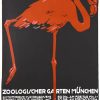
This is a fine art lithograph. It’s an original work of fine art which was produced at the prestigious S2 Atelier in New York City in 1998. It was inspired by a poster first created in 1912. These fine art lithographs are recreations of the original. Great care was taken to precisely re-create the artists original image. Most of the chromists hand draw directly onto specially prepared surfaces that are then transferred onto lithographic plates. Lithography involves creating hand drawn plates, one for each color, which are then ‘pulled’ through antique printing presses one color at a time. The resulting lithograph is in pure color, as opposed to the dot structure which occurs in the photographic process of modern printing. At the heart of the S2 Atelier are it’s two rare, French made Marinoni Voirin ‘editioning’ printing presses ‘ they both date back to the mid 19th century. These are the best fine art lithographs made in the industry today. You cannot find anything better than these. Ludwig Hohlwein (1874-1949) began his career as an architect and evolved into Germany’s most prolific poster artist for both advertising and military posters. His extensive career spanned both World Wars.The Swiss Daily Luzener Tageblatt recognized him as early as 1911 as Munich’s poster king.” By this time, the artist, born in Weisbaden in 1874, was known in Munichfor his paintings, mostly of animals, which he had been exhibiting for a number of years. He was also known for at least two dozen posters that brought something new tothe walls of the city -strong masterly images which were attractive and thoughtfulAlways interested in horse racing and hunting, he was successful with designs depicting the fashionable set and one of his first steady clients was the clothing firm ofHermann Scherrer. By 1910, he was so well known that he received commissions as far reaching as the United States. In 1913, a tobacco manufacturer from his hometownnamed a product after him, Hohlwein cigarettes. He produced four posters for the Munich Zoo in and around 1912. These posters became classics. He also produced some of the first posters for early independent cinema productions in Munich. In general he became known for his depiction of the good life and its status symbols.Stylistically, he created the impression of woodcuts with his starkly composed, contrasting planes and strong lines. His figures are simplified and often compressedinto silhouettes of color or pattern. He was considered a master of lettering -whether using strong, bold capitals, as for the Zoo, or a delicate, ornate hand-script,his lettering was always in keeping with the theme of the poster.A critic of the time observed that Hohlwein’s bold patterns were “rendered with a complete disregard for the forms they are supposed to be covering and as a result,Hohlwein’s posters appear assertively flat, while stressing emphatically the two-dimensional character of his work.””
 |
||
Additional information
| Weight | 0.25 lbs |
|---|---|
| Dimensions | 35.63 × 48.5 × 0.002 in |
Artist: Ludwig Hohlwein
Year: 1912
Type: lithograph
Year: 1912
Type: lithograph
Zoologischer Garten Munchen (Flamingo)
Out of stock
Out of stock